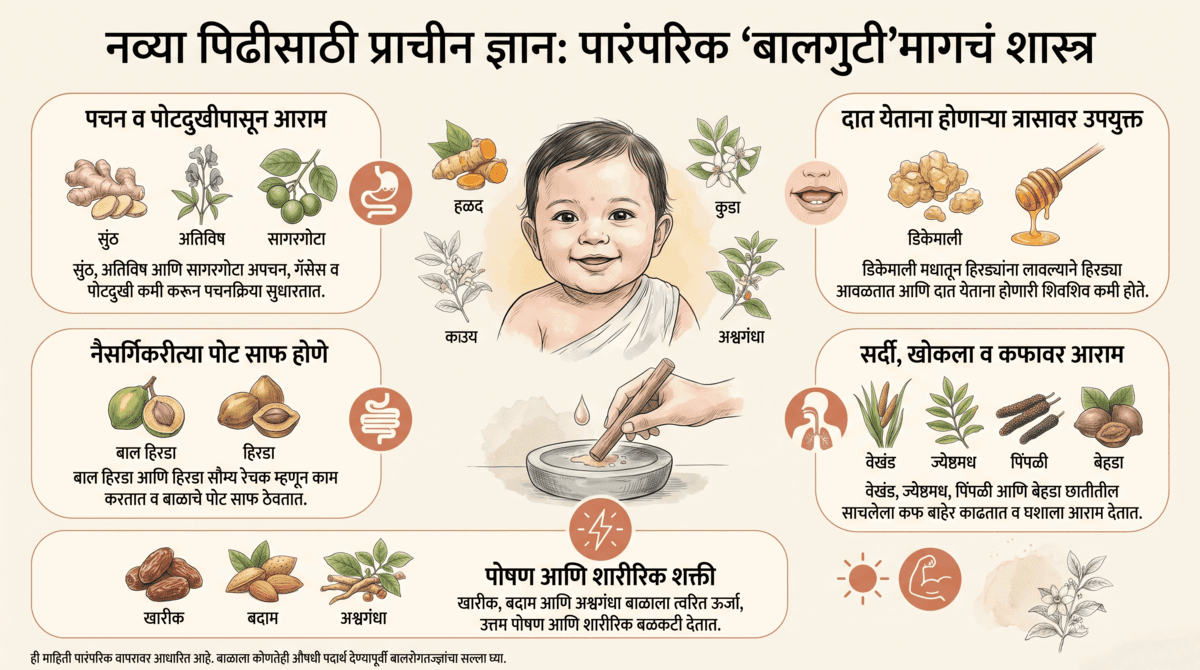
Ancient Wisdom for a New Generation: The Sophisticated Science of the Traditional ‘Balguti’
The first year of parenthood is a journey of awe-inspiring milestones, yet it is often punctuated by the universal trials of the “witching hour”—the relentless discomfort of colic, the exhaustion of sleepless nights, and the irritability of a teething infant.
In our modern quest for wellness, we often find ourselves sifting through complex, multi-ingredient synthetic syrups in search of relief. However, an ancient, “clean-label” alternative has existed for centuries: Balguti.
This traditional herbal toolkit is a prophylactic and strengthening system designed to help an infant’s developing body adapt to the world. Unlike modern medications, Balguti relies on Kashtoushadhi—single-ingredient botanical sticks—offering parents total transparency and a grounded, nature-first approach to family health.
The Precision of the “Rub”: A Sophisticated Dosage System
The preparation of Balguti is a meditative ritual of precision.
Using a sahane (a traditional stone) and a small amount of boiled water or breast milk, parents create a fresh, potent paste by rubbing the herbal sticks against the stone.
This method allows for a highly sophisticated, incremental dosage logic that matches the infant’s growing system.
Traditional Rub-Based Dosage
| Infant's Age | Traditional Quantity |
|---|
| 1st month | 1–2 valse (rubs) |
| 2nd month | 2–3 rubs |
| 3rd month | 3–4 rubs |
| 4th month | 4–5 rubs |
| 5th month | 5–6 rubs |
| 6th month | 6–7 rubs |
This gradual introduction is traditionally intended to ensure that the baby's metabolic and digestive systems are not overwhelmed.
After use, these Kashtoushadhi sticks must be carefully dried and stored to maintain their medicinal integrity for the next day's ritual.
The “Hero” Herb for Modern Toxins: Ativish
In the traditional pediatric pharmacopeia, Ativish (Aconitum heterophyllum) is the “drug of choice.”
While the name might sound intimidating to some, it is traditionally described as non-poisonous. It is also celebrated in traditional medicine for its purported ability to identify and remove poisonous toxins that accumulate in the body.
As a bitter tonic, Ativish is traditionally believed to:
- Correct metabolism
- Purify the blood
- Help clear airways of phlegm
- Support the body during fevers
- Help maintain internal balance and resilience
A Natural Alternative to Plastic Teethers: Dikemali
When a baby’s gums become red, swollen, and itchy—a sensation known as shivshiv—the instinct is often to reach for a plastic teether.
Traditional wisdom offers Dikemali (Cumbi Gum) as a functional botanical alternative. This resin is rubbed into a paste and traditionally applied directly to the gums with honey.
“The paste of the gum is applied to reduce pain and swelling. It strengthens the gums.”
Beyond soothing inflammation, Dikemali serves a fascinating behavioral purpose. Due to its distinct, pungent aroma and stone-like, resinous texture, it is often given to children to help them break the habit of eating soil, providing a traditional medicinal substitute that is also believed to aid in expelling gases.
The “Belly Button” Shortcut: Gentle Topical Solutions
One of the most insightful aspects of the Balguti tradition is the use of the umbilicus (navel) as a gateway for treatment.
By applying herbal pastes externally, parents can traditionally address internal distress without directly taxing a sensitive digestive tract.
Traditional Topical Applications
- For Stomach Pain: A paste of Sagargota and Hing (asafetida) applied to the navel is traditionally used for colic and gas.
- For Loose Motions: A topical application of Jaiphal (nutmeg) is traditionally used to control excessive bowel movements.
- For Constipation: A gentle application of Erandel tel (castor oil) around the navel is traditionally used to soften the abdomen and encourage movement.
- For Sinusitis Prevention: After a bath, Vekhand (Sweet Flag) powder is traditionally rubbed on the baby’s chest and forehead to help ward off infections and clear the sinuses.
Why the “Hirda” Herb is Called a “Mother”
The Balguti tradition holds that many childhood illnesses, from worms to fevers, originate in the gut.
The Hirda fruit is considered so essential to preventing these issues that it is said to “care for the baby like a mother.”
The system utilizes two specific forms of the fruit to maintain digestive rhythm:
Bal Hirda
Bal Hirda, an immature version of the fruit, is traditionally used as a mild laxative for malpachan—the essential process of softening and digesting waste.
Hirda
The mature Hirda fruit is traditionally used to ensure that the stomach is thoroughly cleared (pot saaf).
By encouraging regular bowel movements, these “mothers” are traditionally believed to prevent stagnation and indigestion that may contribute to illness.
The “Mini-Guti” Daily Immune Booster
While traditional sets included up to 20 herbs, the modern “Mini-Guti” focuses on nine essential ingredients for daily prophylaxis.
This potent blend includes:
- Kharik (Dry Date) & Badam (Almond) Nutritional powerhouses traditionally associated with bone strength and brain development.
- Jeshthamadh (Liquorice) A natural sweetener traditionally used to soothe the throat and support digestion.
- Vekhand (Sweet Flag) Also known as Vacha, it is traditionally believed to support speech development.
- Bal Hirda Traditionally used to support gentle digestive regularity.
- Ashwagandha A traditional Rasayan (rejuvenative). It was historically adopted as a botanical alternative to the use of tortoise shells (kasavachi paath) for building skeletal strength.
- Suntha (Dry Ginger) Revered as Vishwaushadhi (“The Universal Medicine”), it is traditionally used to support appetite and gut health.
- Ativish Traditionally used to support metabolism and detoxification.
- Halkund (Turmeric) Traditionally valued for its antiseptic properties and association with blood purification.
- Pimpali (Long Pepper) Traditionally regarded as a stimulant for the lungs and liver. As a “hot spice,” it is traditionally used with caution and precision.
The Fear-Killer and the Nectar: Beheda and Kuda
The Balguti toolkit is rounded out by herbs with profound titles and origins.
Beheda: The Fear-Killer
Beheda, known in Sanskrit as Vibhitak, literally translates to “that which takes away the fear of disease.”
This name reflects its traditional role in supporting immunity and addressing chronic coughs.
Kuda: The Nectar-Born Herb
Then there is Kuda, a plant which mythology claims was born from drops of Indra’s nectar.
Practically, Kuda is traditionally used for severe diarrhea and dysentery. Its bitter principles are described in traditional practice as being particularly soluble in sour liquids, which is why traditional practitioners may prepare the rub using buttermilk for a synergistic effect intended to address harmful gut pathogens.
Conclusion: A Grounded Approach to Wellness
The Balguti tradition reminds us that “advanced” healthcare does not always require synthetic complexity.
By utilizing single-ingredient botanical rubs and respecting the body’s traditional gateways—such as the skin and the navel—we can explore a time-tested, nature-first approach to supporting children’s health.
In a world of mass-produced solutions, could the secret to a calmer, healthier first year be as simple as the time-tested “rubs” of a traditional herb?
Important note: Traditional herbal practices should not be assumed to be medically proven or inherently safe for infants. Babies are particularly vulnerable to adverse effects, contamination, dosing errors, and interactions. Ingredients such as Aconitum species can also be toxic depending on the species, preparation, and dose. Parents should consult a qualified pediatrician before giving any herbal preparation to an infant, particularly orally or on damaged skin.
These remedies support general wellness. Seek medical advice for serious symptoms. See the Balguti Guide